

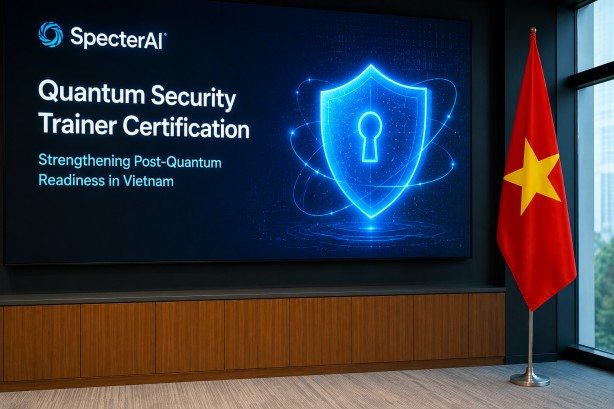
SpecterAI has successfully completed its Train-the-Trainer initiative, empowering three strategic partners to independently conduct quantum security training within Vietnam and Singapore. This significant development aims to assist organizations in transitioning to post-quantum cryptography. The newly certified partners include Vietnam’s HPT and QNet, as well as corporate trainer Edmond Tung from Singapore. These partners are now equipped to deliver SpecterAI’s Quantum-Safe Security Foundations course to a variety of sectors, including enterprises, financial institutions, telecommunications companies, and public-sector entities.
This announcement aligns with recent advisories from Vietnam’s National Electronic Authentication Centre (NEAC), which has urged businesses to brace for the post-quantum era. The NEAC has warned that current public key cryptography systems could become vulnerable with the advancement of quantum computing. By the end of June 2026, nearly 32 million digital signature certificates have been issued in Vietnam, underscoring the magnitude of the impending cryptographic transition.
The training program provided by SpecterAI includes crucial guidance on evaluating quantum-related cybersecurity risks. It employs Mosca’s Inequality (X+Y>Z), a framework designed to help organizations determine the required duration for data security and the time necessary to shift to quantum-resistant encryption. This strategic approach is aimed at expanding regional expertise in post-quantum cybersecurity, allowing certified partners to offer training independently.
SpecterAI emphasizes that early preparation is key to enhancing organizational resilience and ensuring compliance with forthcoming security standards. The company advocates for the development of a quantum security ecosystem across Southeast Asia. Furthermore, SpecterAI encourages sectors such as banking, finance, insurance, telecommunications, and government to integrate post-quantum cryptography planning into their long-term cybersecurity strategies.
Legal Disclaimer: The information contained in this article has been provided by independent third-party contributors, clients, or content partners. We do not independently verify the accuracy, completeness, legality, ownership, licensing, or reliability of submitted content, including text, images, videos, trademarks, or other media materials. The submitting party is solely responsible for ensuring that all content, including images and media assets, complies with applicable copyright, trademark, licensing, and intellectual property laws. We disclaim liability for any unauthorized use of copyrighted or proprietary materials by third parties. If you believe that any content published on this platform infringes your intellectual property rights, kindly contact the author above for prompt review and resolution.