

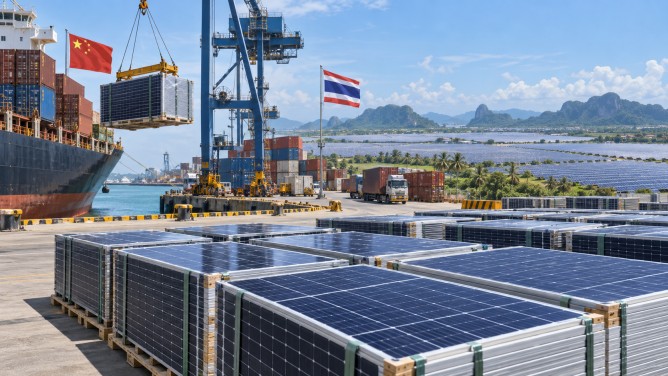
Thailand’s ambitious push towards solar energy is set to significantly impact household electricity costs and bolster the domestic clean-energy sector. As the nation gears up for a large-scale household solar installation program, imports of solar panels have spiked dramatically, highlighting both an immediate reliance on international sources and a future vision for local industry development.
In the first seven months of 2026, Thailand’s solar panel imports surged by 88.7% compared to the previous year, reaching a total value of $426.7 million. A staggering 99.3% of these imports came from China, underscoring the country’s current dependency on Chinese solar technology. The data, released by Thailand’s Ministry of Commerce and Customs Department, also showed that minor contributions came from Singapore and Hong Kong, each accounting for roughly 0.3% of the total imports.
This surge in imports is closely tied to Thailand’s forthcoming initiative aimed at promoting rooftop solar installations. The program is expected to offer subsidies of approximately THB50,000 per household, initially targeting one million homes with the potential to expand to 1.5 million. By reducing electricity costs for households, the initiative seeks to create a ripple effect that could transform the country’s energy landscape.
To support this transition, the Thai government is also exploring strategies to enhance domestic solar manufacturing capabilities. These include potential collaborations with the Ministry of Labour to train workers in key areas such as solar panel assembly, installation, and maintenance. Additionally, discussions with the Board of Investment are underway to consider reducing duties on production inputs that are not sourced locally, which would facilitate the growth of a homegrown solar industry.
The dual approach of importing solar panels and nurturing local production is part of Thailand’s broader effort to establish a sustainable and self-sufficient energy supply chain. By encouraging both rooftop and ground-mounted solar installations, the government aims to significantly reduce household energy expenses while laying the groundwork for a robust domestic clean-energy sector.