

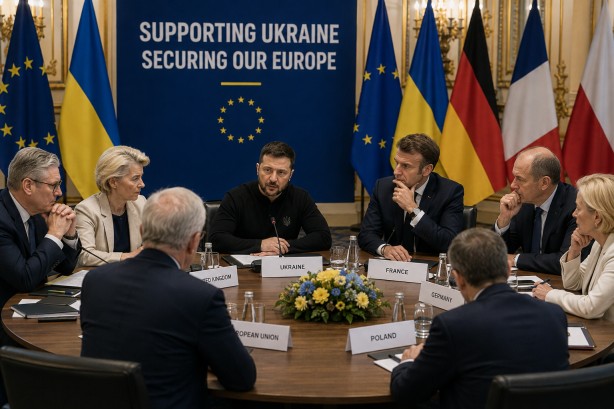
In a significant diplomatic gathering, European leaders are convening in Kyiv to address Ukraine’s pressing need for enhanced air-defense capabilities amid escalating Russian missile strikes. The Coalition of the Willing, spearheaded by the United Kingdom, France, and Germany, is focusing on strategies to bolster Ukraine’s defenses and exert further pressure on Russia. The meeting, which includes the participation of EU Council President Antonio Costa, also sees several European leaders joining remotely.
Recent Russian missile attacks have increasingly targeted Kyiv and other major Ukrainian cities, resulting in civilian casualties and damage to residential areas. In response, Ukraine has intensified its calls for additional air-defense systems and interceptor missiles from Western allies to safeguard its populace. The urgency of these discussions is underscored by the ongoing threat posed by these assaults.
As part of the supportive measures, the United Kingdom is anticipated to reaffirm its commitment to Ukraine, while France is set to announce plans for local production of the SCALP long-range missile. Additionally, France has committed to supplying more interceptor missiles to fortify Ukraine’s air-defense network, a critical component in countering Russian ballistic missile threats.
Ukrainian President Volodymyr Zelenskyy has highlighted a concerning decline in the delivery of Patriot interceptor missiles. He noted that Ukraine had received 675 such missiles in 2023, but the number dropped to 364 by 2025, with projections for 2026 indicating a further decrease to 264. In preparation for the upcoming winter, Kyiv is urgently seeking a minimum of 300 additional interceptors.
Ukraine’s reliance on advanced Western air-defense systems is crucial for defending against sophisticated Russian ballistic missiles, known for their interception challenges. European allies are exploring avenues to increase the supply of these vital defense systems while concurrently maintaining diplomatic and economic pressure on Moscow to mitigate the conflict’s impact on the region.